Showing posts with label Economy. Show all posts

22 April 2012

Car Race Trumps Citizen Rights in Bahrain

Lessee... he, we got a car race! Let's ignore the street protests we've been brutality supressing.

Formula One drivers race in Bahrain on Sunday while rage boils on the streets outside, among protesters who denounce the Grand Prix as a gaudy spectacle by a ruling family that crushed Arab Spring demonstrations last year.
In the Shi'ite villages dotted around the capital, demonstrators hurling petrol bombs have clashed nightly with police during the past week, and security forces responded with teargas, rubber bullets and birdshot.
Black smoke from burning tyres wafted over Budaiya, a village outside the capital that saw mass protests this week.
For those inside the Formula One bubble, far from the scenes of protest, the unrest has had little impact. Teams assembled at Bahrain International Circuit amid the usual security precautions ahead of the race. At hotels where race participants were staying, guests swam and relaxed poolside in the morning. The highway to the circuit was lined with police cars.
The luxury sporting event is the government's chance to show that life has gone back to normal in the island kingdom after security concerns over anti-government demonstrations forced last year's race to be delayed, then cancelled.

See also this earlier post.

By: Brant

08 February 2012

Are Sanctions Working Against Iran?

You never hear about the on-the-ground effects of sanctions against a country. But here's a look at the effect they're having on the average Iranian. Yes, they take a long time to work. But maybe they are actually working?

Malaysia has halted palm oil exports to Iran because of payments problems and Asian oil buyers have cut crude purchases as Western sanctions tighten a financial noose around Iran.
Traders in China said they would cut iron ore purchases from Iran, which are worth over $2 billion a year, because of sanctions that have forced payment defaults on Indian rice imports and prompted Ukrainian and European sellers to stop booking shipments of Ukrainian grain to the Middle East country.
The problems are the most visible evidence to date that Western sanctions are squeezing Iran's trade.
Iran's crude oil buyers, including China and Japan, are cutting purchases, reducing the OPEC producer's earnings from its major source of the foreign exchange it needs to pay for critical imports, such as food staples.
The problems have come to light after U.S. sanctions this year targeted Iran's central bank and the European Union decided to ban Iran crude imports in an effort to force Tehran to abandon a suspected nuclear weapons program.
Iran's rial has plunged as the West increased sanctions, raising the price of imports for the economy and making it difficult to find Dubai-based middlemen who can process payments to keep the country's trade flowing.
Bread and rice dominate the diet of most Iranians, many of whom can no longer afford to buy meat, now selling for about $30 a kilogram in Tehran.


By: Brant

15 January 2012

When Sanctions Aren't Enough

Would the US really assassinate an Iranian scientist?

Iran said on Saturday it had evidence Washington was behind the latest killing of one of its nuclear scientists, state television reported, at a time when tensions over the country's nuclear program have escalated to their highest level ever.
In the fifth attack of its kind in two years, a magnetic bomb was attached to the door of 32-year-old Mostafa Ahmadi-Roshan's car during the Wednesday morning rush-hour in the capital. His driver was also killed.
U.S. Secretary of State Hilary Clinton denied responsibility and Israeli President Shimon Peres said Israel had no role in the attack, to the best of his knowledge.
"We have reliable documents and evidence that this terrorist act was planned, guided and supported by the CIA," the Iranian foreign ministry said in a letter handed to the Swiss ambassador in Tehran, state TV reported. The Swiss embassy represents U.S. interests in a country where Washington has no diplomatic ties.
The spokesman for Iran's Joint Armed Forces Staff, Massoud Jazayeri, said: "Our enemies, especially America , Britain and the Zionist regime (Israel), have to be held responsible for their actions."


By: Brant

02 January 2012

MidEast Arms Sales and Elections

Looks like we might have an answer for our poll last week... fighter sales to the Middle East could well be an economic issue tied to election campaigns.

Booming Middle East purchases of U.S. fighter jets will be a bright spot in what is expected to be a sluggish economy in 2012, possibly paying dividends for President Barack Obama's bid for a second term.
Beneficiaries include Lockheed Martin Corp and Boeing Co, whose respective F-16 and F-15 production lines are being extended by U.S. government sales to Iraq, Saudi Arabia and Oman, among other rich arms deals announced in recent weeks.
The foreign sales will help offset expected cuts in big-ticket purchases by the Defense Department, which is set to lose at least $450 billion in previously projected funding through 2021 as part of a deficit-reduction push. Additional cuts totaling another $500 billion to $600 billion over the same period are scheduled to kick in next year unless a new deficit-reduction plan is adopted by Congress.
The sales of fighters, missiles and other advanced U.S. weapons will help provide jobs as the United States heads into an election campaign expected to focus on the domestic economy. It has been growing at only half the pace needed to get the jobless rate down from 8.6 percent, a problem for Obama as the incumbent.


By: Brant

29 December 2011

Can Iran's Ass Cash the Checks Their Mouths Are Writing?

They're threatening to close the Strait of Hormuz. Can Iran really do it?

Since it doesn't have nuclear weapons yet, Iran is playing the lone trump card in its hand: threatening to shut down the Strait of Hormuz through which Persian Gulf oil flows to fuel much of the world's economy. Iranian navy chief Admiral Habibollah Sayyari told state television Wednesday that it would be "very easy" for his forces to shut down the chokepoint. "Iran has comprehensive control over the strategic waterway," he said as his vessels continued a 10-day exercise near the strait.
But just how good a trump card is it?
"Iran has constructed a navy with considerable asymmetric and other capabilities designed specifically to be used in an integrated way to conduct area denial operations in the Persian Gulf and SoH, and they routinely exercise these capabilities and issue statements of intent to use them," Jonathan Schroden writes in a recent report for the Pentagon-funded Center for Naval Analyses. "This combination of capabilities and expressed intent does present a credible threat to international shipping in the Strait."
Not so fast, other experts maintain. "We believe that we would be able to maintain the strait," Marine General James Cartwright, then-vice chairman of the Joint Chiefs of Staff, told Congress last year. "But it would be a question of time and impact and the implications from a global standpoint on the flow of energy, et cetera, [that] would have ramifications probably beyond the military actions that would go on."


By: Brant

28 October 2011

What's Worse: The Internet Moron, or the Discussion Mod Who Protects Him?

So Danger Room has an article up about the defense industry making budget cuts into an economics/jobs issue, and you expect from most of Ackerman's work, it's a hack job poking fun at big defense corporations.

What's really fun, though, are some of the comments. There are twits quoting Ike and the military-industrial complex, and others bitching about how senior military folks go to work for contractors*, and others griping about how the acquisitions process is so assed-up that it jacks up costs through the roof. Now, that last gripe is quite legit, as is the one quoted below.
* sidebar: what would those same twits bitch about if you weren't allowed to go work for the defense industry after military service? probably that weapons were being designed without leveraging the talent and experience of retired military folks...

MisterWhiskey
Why can't they be retasked with solving our energy dependence? Local powerplant creation? Why is it always bombs, bullets?

Ah yes, the internet moron. You see, Danger Room (where this appeared) has consistently reported on the efforts the US military are undertaking in search of greener fuel alternatives. And yet, when I've tried - three times now - to post a reply to Mr Whiskey, it's been rejected by the mods on the site.
You mean the way DARPA and the USAF have been working on alternative jet fuels for 3 years now? (as reported in Danger room in 2008: http://www.wired.com/dangerroom/2008/09/darpas-coal-to )
Or the way the Marines have cut fuel use by 90% in Afghanistan by going green? (as reported in Danger Room this year: http://www.wired.com/dangerroom/2011/01/afghanistans-green-marines-cut-fuel-use-by-90-percent/ )
So tell me, Mr Whiskey, now that you got your wish - and didn't even realize it - what's your next criticism?

Now, I don't know who's mod'ing the comments at DR. I don't know if it's Ackerman, but it wouldn't surprise me (he's clearly not spending his time on nuanced research). But there seems to be only two reasons why my comments wouldn't get approved:
1. They're seen as off-topic. I have a hard time buying this, given how far off-topic so many other comments are in this thread.
2. They shoot holes in the groundswell chorus of complaints about how the defense industry is hurting the economy, and they do so using DR's own posts. Given Ackerman's behavior on other threads, I wouldn't put this past him if he was mod'ing his own boards.

Now, I wouldn't think my comments would be so consequential or dangerous as to need suppression over at Danger Room. Maybe I'm just (unofficially) blacklisted for beating up on Ackerman and his sock puppets over his Islamobating with the FBI, but again, that seems a little extreme for a guy without a big posting profile over there.

Anyone got any ideas about why these comments wouldn't make it into the discussion thread?

More importantly, anyone got any ideas about how we get Noah Shachtman back on Danger Room and boot Ackerman to the curb?

By: Brant

10 October 2011

Keynesian Economics and Military Spending

So there's a study out there that tries to show that military spending has a signficant economic effect beyond the raw dollars committed.

... it turns out that military spending is actually a singularly good proxy for measuring just how big the multiplier for government spending is. A new paper by Jón Steinsson and Emi Nakamura, assistant economics professors at Columbia, looks at boosts in military spending over the past half-century and separates their impacts in states with lots of military contractors and personnel, and those with relatively few—specifically, California and Illinois. The difference allows them to run a regression to see how much the extra military spending boosted the economy.

One reason that military spending was easy to analyze in depth, as the article points out, is that military spending is archived in meticulous - and usually public-accessible - detail.


By: Brant

04 October 2011

China Talks War While the US Prepares to Disarm

Now, for an unusually opinionated post... I suppose this is on topic because even the outgoing Chairman of the Joint Chiefs of Staff has recognized that financial and economic issues are the greatest threat to the national security of the United States.


According to a UPI article, an official Chinese newspaper is calling for war against the Philippines and Vietnam over natural resources in the South China Sea:


"The time to use force has arrived in the South China Sea; Let's wage wars on the Philippines and Vietnam to prevent more wars."

Meanwhile, the US is on the road to gutting our military because we can't get over the partisan bickering over the budget, never mind actually address the systemic issues in the economy.


On the bright side, if China makes a military move on the Philippines or Vietnam, it would be the perfect opportunity for us to impose a trade embargo and cancel their debt holdings. It would be rough at first because we are so dependent on their exports, not just for junk like the "Soldier Force VI" toy set I saw in Rite Aid the other day or for luxuries like iPhones, but for necessities like pharmaceuticals.


However, in the mid- to long-term, we could re-build the domestic industrial base, put a big dent in unemployment, and end up with a more sustainable and self-sufficient economy. At the same time, launch a serious crash program for sustainable energy sources. Let China have the oil. We wouldn't need if we got serious about the wind, the sun, the Earth's heat, fuel cells, hydrogen combustion, nuclear fusion, and other 21st-century energy sources.


Best of all, we wouldn't necessarily have to fire a shot or put a single American service member in harm's way.


By: Guardian

21 September 2011

The Problem with the Long Run

"In the long run we’re all dead." -John Maynard Keynes

The problem with the long run is that eventually it gets here.

Military planning spans the gamut from large potential near-peer conflicts, to small, asymmetrical engagements across the globe. Lately, the trend is toward thinking about China. Whether it is over the Taiwan Straits, the Spratly Island chain, Vietnam, or North Korea, China is the new pacifier for all the cold-war enthusiasts who pine for the simpler days of bipolarity in the international system.

I’ve argued elsewhere that the notion of fighting a war with China is absurd. What’s more, from a strictly military perspective, there are much more immediate and problematic issues that require greater focus, such as a Mexican failed state on our southern border. But in truth, I now believe that all of that thinking ignores the 600 pound gorilla standing in the room. What planning exists in the military to cope with a collapsed dollar?

One reason I say that the idea of a war with China is absurd is because that war has already been lost. It’s time, once again, for some economics. Let’s start with a number:

14,713,992,331,505.17

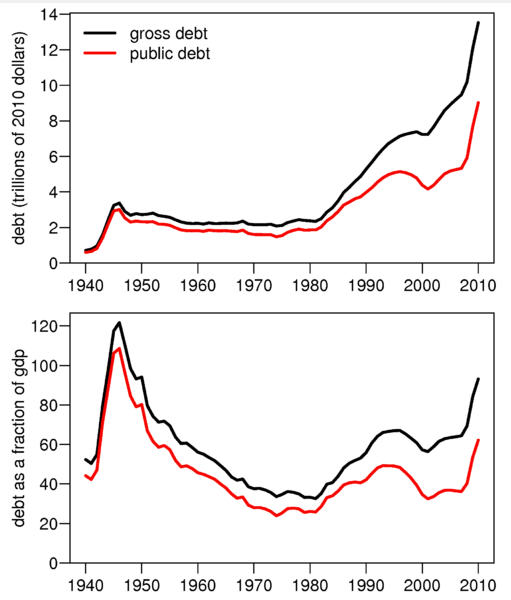
That number, at the time I’m writing this, is our national debt. Let’s have a look at what our national debt has been doing over time (according to the US Govt.):


That debt is currently increasing at a rate of 4 billion dollars PER DAY. Who is lending us all this money? Let’s have a look at who owns our national debt:


China owns seven and a half percent of our national debt, which works out to $1,103,549,424,862.89 (1.1 trillion dollars). Worse yet, oil exporters hold a large portion as well. And just who are these "oil exporters?" Why it’s Ecuador, Venezuela, Indonesia, Bahrain, Iran, Iraq, Kuwait, Oman, Qatar, Saudi Arabia, the United Arab Emirates, Algeria, Gabon, Libya, and Nigeria.

This very morning, Fed Chairman Ben Bernanke announced that the Fed would likely try even harder to lower interest rates, and since short-term rates are pretty much already zero, they’re going to go back to the 1960’s playbook and move short-term securities into longer-term holdings in an attempt to bring long-term yields closer to short-term. What is the point of that? It’s to try and push you, the consumer, into doing one thing: spend your money. For some reason, the Fed and our government have adopted the notion that the only sign of a good economy is people spending money on consumable goods. (As an aside comment, this is what happens when you put cool-aid-drinking modelers in charge of something.)

So take a wild guess what the national savings of the United States is. It’s -619,175,676,960.00 (that’s NEGATIVE six hundred BILLION dollars). There aren’t very many countries out there with negative national savings rates and the bulk of those are third world countries and failed states.

Well here’s where things start to get problematic. As of August of this year, our inflation rate according to our kind and benevolent government was 3.77 percent. Compare that to the ten-year yield on a US Treasury bill which is currently just under two percent, and perhaps you see a problem? If not, let me spell it out for you. If you bought a ten-year T-bill today, when it matures it will be worth less, in real money terms, than when you bought it. In other words, what is going on here is that the Fed and our government are purposely devaluing our currency for the express purpose getting you to consume, using borrowed money, in order to artificially pump up the economy. Do you truly think that can last? Well it can’t. Here’s why.

Let me first talk a little about the inflation rate. What I listed above as the inflation rate is called the "core" inflation rate. That rate of inflation is calculated using a basket of goods and tracing the price of those goods over time. What’s in that basket of goods is much less important than what isn’t: food and energy. Ostensibly, these two items are left out because it is feared that including them would bias the numbers because of short-term price issues. But in reality, including them always makes the rate higher, often much higher, than the core rate, which is the inflation rate that our government chooses to tell us about. In reality, our current inflation rate, accounting for food and energy, is substantially closer to ten percent. This imbalance between inflation and interest rates is why we constantly hear about how the purchasing power of US consumers has actually decreased relative to necessities, even though it has increased relative to other consumables such as electronics, etc. It is also why our currency is being devalued.

So why aren’t we seeing much more severe inflationary effects? The reason is because of trade imbalance. Most of the goods we consume are made in China, which means the money we spend for them go to banks overseas, and are not part of the money circulating in our economy, but rather in someone else’s. This is possible due to the reserve status of the US currency. Foreign nations hold US dollars due to its reserve status, and I’ve already shown you above just how much money that actually is.

Currently there are movements in the international system to move away from the US dollar to some other reserve currency. Chief among the folks wanting to do this are Russia, most of the oil producing nations and, you guessed it, China. So what happens if the US currency is no longer the reserve currency of the world?

Very simple. Nations holding US reserves will seek to spend those reserves in the only place that they can: the United States. Imagine, for a moment, the inflationary effects of a sudden infusion of several trillion dollars into our economy, as foreign nations seek to purchase anything that they can in the US. To put it simply, our economy will collapse under the weight of cripplingly high inflation rates as other nations dump their holdings in US currency, which is to say nothing of the exacerbating effects of "quantitative easing," which the Fed also announced this morning it is considering another round of. When you add to that the reality that US manufacturing has all but disappeared, the ramifications are staggering.

China will have won the war without ever firing a shot. In truth, they already have. All they need do is pull the trigger. Which gets me back to the opening points in this discussion. What plans are being made in the US military to help this nation survive that trauma? I’m fairly certain that the answer is none. The US military industrial complex currently operates under a single over-riding assumption: that the gravy train of the defense budget will never end. I’ve got bad news. It’s about to.

As much as we love our expensive gadgets, they are simply untenable. If the US Military does not start planning on how to remain an effective force using a fraction of their current budget, then they do a disservice to our country.

It is my belief that at this stage it is simply too late to prevent what is going to happen to our economy. It will happen, and it will happen sooner rather than later (and the longer we put it off by artificially propping up the economy, the worse it will be). We need to start planning on how to survive the event, and come out the other end a stronger, more agile, and more fiscally responsible nation. The members of our military take an oath to defend our constitution. It is time for them to do some soul searching over what that really means when the financial status-quo changes drastically for the worse.

By: Jon Compton

16 August 2011

The Money Quote

“When I look at a guy who has to report to drill every month, as a manager and as a hirer, I have to think about that,” he said. “I know he’s gonna be asking for a lot of days off, and that isn’t easy to give. Some guys come back from the war with all sorts of issues, which is understandable, but I have to deal with that. Honestly, I think about it twice before I hire them.”


No one will admit this. They can't. It is as socially acceptable as admitting you like to fart in church to have the pew to yourself. But the truth is that guys in uniform see this every single day. It's just taken Jonathan Raab to write down and tell the story of what everyone's been thinking inside. His story is compelling, and hardly unique. But it's a story that needs to be told - has to be told - again and again and again, until the rest of America 'gets it'.

“Everybody wants to support the troops until they have to share in the hardship and sacrifice,” I said. “Then all of a sudden that bumper sticker or that flag pin doesn’t mean anything anymore.”


By: Brant

03 August 2011

GameTalk - Economics (re-run!)

(note: we are re-running this post, because it got no previous comments because no one knew what the hell the GameTalk series was all about back then...)

At what level do economic concerns enter wargames? Where do military events affect economic concerns such that they feed back into the military capabilities? How do you model economic effects in games that are primarily about military exchanges?

What are some un/successful military-economic model integrations you've seen and what are others you'd like to see? Where have designers got it right, and where have they just flubbed beyond belief? What's the lowest echelon where you've seen economics integrated? Have you seen any essentially economic games with a military component grafted on?


By: Brant

24 February 2011

Ah the Free Markets... Everywhere but the Defense Industry

Ironic that the largest 'free market' economy in the world spends trillions of dollars in an inherently closed market with a limited number of providers.

There are obvious reasons for that. One is the powerful vested interests who resist making consequential changes. The other is intellectual. It is impossible to think seriously about defense budgets and Pentagon resource allocations without a clear idea of what we expect our military to do -- and why. In other words, the place to begin is with interests, needs and means. We don't do that. The production of strategic statements has become an art form for obfuscating half-baked ideas and flawed logic. Its main reference points, beyond an extrapolation of the status quo, are domestic politics and intra-governmental turf battles. This holds for budgetary plans as well.

To be honest, we're navigating without a strategic gyroscope and only the most primitive of compasses. There is no strategic design -- certainly not an explicit one -- that is coherently articulated. Instead, there is an arithmetic tabulation of threats. There's the Islamic terrorists. There's China. There's defending Latvia from the Russians. Then there's oil from the Persian Gulf. Then there's the Western Hemisphere with Hugo Chavez and drug cartels. Then, then.... Implicit in this iterative approach is the assumption that our tolerance for any magnitude of threat is zero, that we must prepare for threats 'over the horizon,' and that we must be pro-active. There is a logic to this way of thinking, however rudimentary. But only if you can count on infinite resources -- and if you cannot imagine that any of our actions may be counter productive for national security. Alas, neither is correct. Any tacit recognition of the former is unaccompanied by any strategic assessment worthy of the name.

The 9/11 decade has been dominated by the 'war on terror.' Its huge appetite for resources, including time and energy, has been matched by the progression of perceived security needs it has spawned. The commitment to a dominant physical presence in Southwestern and Central Asia is the outstanding example. Let's look at each in turn. Our vast expenditures in Afghanistan and Iraq to little beneficial effect testify to the obsession with Islamic terrorism. They are explicable only in terms of the Twin Towers trauma and the newfound sense of vulnerability it created. Looked at objectively, the losses we suffered -- however dramatic -- do not figure high on a scale of possible attacks against to the United States. Certainly not compared to what a couple of thousand Soviet nuclear warheads could do to us.


By: Brant

20 December 2010

GrogNews Daily Headlines


The Brits have started making some arrests in anti-terror raids across the country.

The DoD has released a new report on sexual harassment/assaults at the military academies, and finds that the number of assaults being reported is going up. Unknown is whether it went up because the overall number went up, or because more are being reported.

How far has Afghan war coverage dropped off in the US? The New York Times says it's down to 4% of coverage. No doubt everyone is focusing on the budget and the US fiscal meltdown. Which begs the question, should the US try to cut its deficit by scaling back on the overseas wars?

Emboldened by their DADT victory, Democratic leaders in Congress are pushing ahead on ratifying START II. Even with the DADT repeal this past weekend, some restrictions remain.

The Norks pussied out. I mean, really, how else would you put it?

By: Brant

19 November 2010

GrogNews Daily Headlines, Bonus Edition

There's just a lot of news today...


As the US is now following the lead of the Canadians and sending M1-series tanks to Afghanistan it's amazing what we are still learning about the Afghans. Turns out most of them have no idea about 9-11 or why we're at war there. In fairness, there's probably a lot of Americans that are pretty ill-informed, too.

While the US and Israel are having a hard time hammering out a settlement pact the People's Republic of Jihadistan in Gaza launched a long-range Grad rocket at their neighbors. Religion of Peace, indeed.

How was the cybersabotage of Iran's nuke plant supposed to work? By overloading commands to the centrifuge.

With capsizing safely off the table as a danger for the military relocation to Guam, lawsuits have taken center stage, as a live-fire range is apparently too close to some endangered sand or something.

Lockheed is going to shut down a plant in Minnesota, and probably blame Congress for it.

The US is trying to cut off access to drug money for the Norks, and hopes that sanctioning some of their "commercial" entities will keep other nations from working with them as well.

By: Brant

11 November 2010

GrogNews Daily Headlines

(running later so as not to interfere w/ our Veterans' Day articles)

Were Raytheon layoff announcements delayed until after the elections?

With budget cuts looming, the F-35 JSF is back in the crosshairs.

There's been a report commissioned that shows there would be little risk to the war effort if DADT is repealed.

The Iraqis might finally have a deal for their government, and it looks like the Kurds are on board.

The Russian media thinks they have identified the 'double-agent' that turned in the world's least-dangerous spy ring.

By: Brant

10 November 2010

US Politician Throwing a Hissy-Fit

Look Senator, I get it: you want to protect jobs in your state. Check. But if the jobs you're seeking to protect (a) should've never existed to start with, and (b) are actually counterproductive to the war effort, why are you fighting so hard to hold onto them? More to the point, why are you hamstringing the careers to two fine generals just to make a public point about your blatant rent-seeking homerism?

Sen. Jim Webb (D) has alerted the Department of Defense that he will put a hold on all civilian and flag officer nominations until he gets more information about the decision-making process to Secretary Robert Gates' recommendation that the Joint Forces Command in Norfolk be shuttered.

The move elevates Webb's demand for information from the Obama administration and comes just a week before the midterm elections. The decision by the Obama administration's defense secretary to close JFCOM as a cost-saving measure has been a major campaign issue in a race between Democrat Rep. Glenn Nye and Republican Scott Rigell.

Members of Virginia's congressional delegation of both parties have said they were blindsided when Gates announced the recommendation, part of a plan to trim the Pentagon's budget in coming years. They have subpoened the Defense Department, insisting that the Pentagon has been stonewalling their request for more information about how the decision was reached.

"This failure to respond to a request for basic information that should be readily available is indicative of the lack of cooperation that has characterized the proposal to close the U.S. Joint Forces Command (JFCOM)," said a statement from Webb, a former Secretary of the Navy. "Such data is highly relevant to our ability to reach our own conclusions in the fulfillment of our constitutional responsibility to assess a proposal that has significant ramifications not only in Virginia but throughout the country and also overseas."


By: Brant

09 November 2010

GrogNews Daily Headlines

Delayed by the endlessly-rebooting laptop... grrrr....

It looks like the express-post industry would hate to have cargo screening - and flight safety - interfere with corporate profits.

If the US sits on the new START treaty, they may pay for it in lack of cooperation from Russia elsewhere.

A Republican defending the cost of the President's trip to India? Oh, and it's not $200 million/day. Hell, the war in Afghanistan is only $180 mil/day.

And for that price, we ought to know whether or not we're succeeding in Khandahar.

The Israelis sure no how to dial down the tension, huh? Like announcing they plan to build a crapload of homes in Arab East Jersusalem.

Is China trying to spike a UN report about Nork nuke dealings?

By: Brant

08 November 2010

GrogNews Daily Headlines

Y'know, even if they weren't involved, you had to know that Al-Qaeda was going to claim credit for the toner cartridge mail bomb plot that had intel agencies around the world racing against time to track down the bombs. Oh, and apparently one of them actually wasn't only 17 minutes from exploding. In the wake of the busted plot, though, UAE airlines have banned all Yemen cargo on their aircraft, and the US is seeking more (and better) intel-sharing from Yemen.

Another day, another mosque bombing in Pakistan. Good thing AQ/Taliban are fighting the infidels, eh? Turns out that the Indians think that the Pak military is against any peace talks, and why wouldn't they think that, after the ISI claims that the Taliban are dependent on Pakistani protection. Even with all the drama, senior leaders in the Pentagon think that the Afghans will be ready to manage their own security by 2014, or about 3 years after the President thinks the surge is supposed to end.
Oh, and in a move guaranteed to keep Pakistan in our good graces, President Obama apparently supports a permanent seat for India on the UN Security Council. Way to win friends and influence people there, boss.

In other headlines:

Secretary Gates is trying to assure China that US military moves in Asia are not directed at them. After all, where would the US (except San Francisco) get our Happy Meal toys if we started any sort of dispute with China?

Lil' Kim (Nork version) is climbing the "corporate" ladder again. Thanks, daddy!

And some Nigerian militants have seized a group of workers from an oil rig.

By: Brant

03 November 2010

GrogNews Drive-Thru of Other MilBlogs

Taking a quick afternoon loop through some other great content on the web, we want to draw your attention to the following...

DefenseTech asks a very provocative question about the role that corporations will play in future security issues. It almost makes you wonder how prescient Tomorrow Knights really is...

Critical Threats has a very pessimistic assessment of the current situation in Mogadishu, pointing out that, among other things, the government is rather powerless even its own 'capital' and that the AU is the only thing keeping it close to in power.

Agile Flux has some very good points about knowledge management in the military space.

An Afghan journalists laments the half-hearted attempts at democracy there, and describes the corruption that de-legitimizes the electoral process. Oh, and they want to throw out the US with the Taliban...

How important are human relationships when fighting terrorism? DefenseTech has the latest article, but Shachtman pointed this out almost 4 years ago in WIRED. And FusionNET had cracked that code back in 2005 for XVIII Airborne Corps, and Map-HT is relearning that lesson now, and CIDNE continues to insist that anyone who wants their information to solve the same problems has to go through them.

By: Brant

Hasbro, Stratego Parting Ways After 50(!) Years

OK, this is barely a wargaming story, but I felt it needed a mention. According to a the press release from back in May, this is it for Stratego, as published in the US by Hasbro.

Royal Jumbo, part of JumboDiset, one of the leading European Toy Companies based in The Netherlands, herewith announces that the Stratego license agreement with Hasbro that will expire at the end of 2010 will not be renewed.

Royal Jumbo and Hasbro have enjoyed a successful cooperation for Stratego that lasted almost 50 years. Strategic changes in both companies ultimately drove the decision not to renew the license after its regular expiration.

Arend Smit, CEO of Royal Jumbo comment: “it is with regret that we part ways with Hasbro. This was not an easy decision in view of our 50 year long relationship. Hasbro helped to build the Stratego brand in North America and we are thankful for that. However, we now have to accept the reality the strategic views have diverged and move on with confidence for the future.

Hasbro will have the exclusive distribution rights of Stratego until the end of 2010.


Now, I doubt that there'll be a sudden rush on Stratego sets at Christmas this year, but still, it's definitely the end of an era coming up in a few months.

By: Brant